
What is Worldbuilding … and How Detailed Do You Need to Be?
Wonderland. Narnia. Hogwarts. Middle-Earth. Westeros.
These are all famous story worlds … and if you've read any of the books they feature in, they probably instantly conjure up a sense of escaping into that place.
If you're writing science-fiction or fantasy, part of the prewriting (ideas, planning and research) stage of your process will involve worldbuilding.
This is an area that a lot of writers get a bit stuck on. Either they feel daunted by the whole idea of worldbuilding, so don't start at all … or they spend month after month on worldbuilding, at the expense of actual writing.
So how can you create a unique, engrossing story world without getting stuck at the worldbuilding stage?
That's exactly what we'll be digging into today.
What is Worldbuilding?
Worldbuilding is the process of creating your own unique setting for your story. The fictional world you build could be a city, country, planet, or even an entire universe. You don't need to craft every detail of it, of course, but you do need enough information to make your story world feel convincing.
During the worldbuilding process, you'll come up with things like the geography and history of your world, the culture(s) involved, any sentient races beyond humans (e.g. elves in a fantasy novel or aliens in a science fiction novel), religions, how the magic system works (if your world involves magic), what kind of technology the world has, what sort of political system there is,and plenty more. You don't necessarily need a lot of information on these: what matters is how the world impacts on the characters and plot.
Depending on your story, your world might be entirely separate from the real world, or it might be an alternative past, present, or future version of our world, or a different location within our galaxy. It's easy to assume that fantasy takes place in a wholly made up world and science fiction takes place in a future version of our world … but this isn't inevitably the case (think how Star Wars takes place a long time ago in a galaxy far, far away – or how Harry Potter takes place in the UK, but with a hidden wizarding society).
Is Worldbuilding Just for Fantasy and Science-Fiction Authors?
When you hear the term "worldbuilding", it's often associated only with science-fiction and fantasy writers… but I think most authors do at least a little bit of worldbuilding.
If you're writing historical fiction or a story set in a different country to your own, you'll be doing research to find out the facts about that place – but you may also be filling in some details with your imagination.
If you're setting a contemporary story in a familiar location, you may still be crafting some details, like the geographical layout of your imagined small town for your cosy crime novel.
So while the full worldbuilding process assumes you're creating a world that's significantly different to the (current or past) real world, parts of the process can be helpful in almost any genre.
Two Different Approaches to Worldbuilding (the "Pantsing vs Planning" of Worldbuilding)
Just as some authors like to plan their story extensively in advance and some writers prefer a "seat-of-the-pants" writing process where they make it up as they go along, different writers will take different approaches to worldbuilding.
At one end of the spectrum, you have authors who like to spend months, even years, coming up with every detail of a story world. They might write imagined histories of the world (Tolkien did for Middle-Earth, particularly in the Silmarillion). They may draw detailed maps, come up with multiple religions, work out a whole economical system, create a fictional language (often called a conlang, a constructed language).
And at the other end of the spectrum, you have authors who want to dive straight into writing with only vague ideas about the world in which the story's set. Just like the plot, the world begins to emerge more clearly during the writing process: they may figure out new pieces of the puzzle only as these are needed (e.g. as the protagonist first journeys out of their own small town).
For most authors, the sweet spot is somewhere between these two approaches. You probably don't want to spend years of your life meticulously building a world only to never get round to actually writing your novel … but you also don't want to dive in so quickly that your setting feels thin, improbably, or cliched.
The Biggest Question That Affects Your Worldbuilding
There's one key thing you need to know before you go further with worldbuilding:
Is your story set in a version of our world?
That might be:
- An alternative version of history (e.g. steampunk)
- A future version of the Earth (e.g. dystopian)
- A contemporary version with fantasy/SF elements (e.g. paranormal)
It doesn't necessarily need to be recognisably Earth, but at some point, it'll be clear to readers that your world is based on the real world. Think The Hunger Games, which is set in a futuristing North America, with the Capitol in the Rocky Mountains, and District 12 in Appalachia.
If your story is set in a past, present, or future version of the Earth, that's going to affect your worldbuilding to some extent. You might have real-world animals, for instance – or corrupted versions of them.
You might use real-world geography, even if places have different names, or you've added additional locations – in the Skandar books, for instance, there's an island in the Irish Sea where unicorns exist.
If your story isn't set in any version of Earth, then you've got considerably more latitude to make up things like how physics works in your world, what kinds of animals there are, what level of technology exists, and so on.
(Another option to consider is an entirely new world that's linked to Earth in some way – either through supernatural means, like Narnia, or through something like a wormhole.)
Five Key Aspects of Your Story World to Consider
Before we dig into the different aspects of your story world to think about, a quick note on worldbuilding questionnaires.
There are loads of different worldbuilding questionnaires out there. As with character questionnaires, the danger of these is that you can get very wrapped up in inventing minutia, without necessarily thinking about how this is going to work in terms of the actual story. You may find yourself spending a huge amount of time filling out a questionnaire, only to end up changing your mind on a lot of the details as you get further along in the writing process.
Absolutely use a questionnaire, if it's a useful tool for you, but don't feel that you need to complete all the details before you go further with plotting, characterisation, and so on.
With that in mind … here are some key things to consider. For each area, I've given examples of the types of questions you might want to think about.
#1: Physical Geography and Environment
Whatever kind of world you're building, you need to know how it's laid out. Is it a vast, barren landscape dotted with a few cities … or are you writing about a world where everything's much closer together? Is the weather calm and temperate, or do huge freak storms stop all travel for months at a time?
Many writers like to draw maps and figure out different regions or locations for their story. If you're using the real world as a basis, you might want to create a custom map in Google My Maps and add pins for key locations.
#2: Politics and Economy
How is your world governed? Are there monarchies, democracies, dictatorships, or some other system in place? Do different countries or even different cities have different systems? What levels of government are there? (E.g. is there a High King with other kings beneath him?)
What kind of economic system is there? Are characters using coins (and are these symbolic, or valuable in their own right)? Is there a system to track credits/debits? What's an average wage? What's the gap between the richest and the poorest?
When it comes to politics and the economy – and indeed any aspect of world building – you don't need to have lots of details. You just need enough information that you know how these areas impinge on your main character(s).
#3: Society and Religion
How is society organised in your character's world? Perhaps there's a strict class hierarchy, or there are complicated social rules and taboos – maybe arising from other aspects of your worldbuilding.
Does your character follow a religion? Is this mainstream or unusual in their world? You might want to think about whether your world has multiple religions, and how these interact. What importance does religion play in society as a whole?
And keep in mind that unless your world has been created out of nothing, very recently, it's going to have some history (which social roles and specific religious beliefs will have developed from). This might be well-known to the characters or shrouded in myth and legend.
#4: Language(s)
What language do people speak in your story world? If it's a past, current, or future version of America or the UK, they may well be speaking English – or something derived from English. In a fantasy world or on a different planet, you don't necessarily need to explain that your characters are speaking their own native language: just write as normal, and we'll assume it.
Languages become significant if not all your characters speak the same one, or if differences in how language is used signal important social, political, or religious distinctions. Issues of language could form part of your plot (in Embassytown, the protagonist has become part of the Ariekei tongue as a figure of speech; in The Long Way to a Small Angry Planet, the protagonist's knowledge of different languages proves useful).
#5: Technology and/or Magic
This is really at the heart of worldbuilding, in many ways: what's truly different about your world is likely that it has technology beyond what we currently have on Earth (science fiction) or there's some kind of magic or supernatural force (fantasy).
These technological or magical differences can be relatively minor or tangential to the plot: for instance, perhaps magic is very rare, outlawed, or all but forgotten in your fantasy world, or the only "magic" present is a portal between two worlds. With technology, you might be writing a more character-driven science-fiction, with little or no technology mentioned beyond what we currently have … or a post-apocalyptic novel, where a lot of tech we rely on is gone.
This is far from an exhaustive list! You don't need to know everything about each of these areas … and depending on the kind of story you're writing, you may well want to go into a lot more detail in other areas. (For instance, perhaps the way parenting works is very different – children are raised communally, for instance, or by robots.)
Are You Putting TOO Much Worldbuilding Into Your Story?
As with pretty much anything in your novel (or indeed in life!) … you can have too much of a good thing.
Readers will enjoy getting immersed in your world and learning about the details of it, but they won't want you to halt the story to deliver a lecture about the intricacies of your invented economy.
With worldbuilding, as with research in general, you'll probably find that you have notes about a lot of things that don't make it explicitly onto the page. All of that still enhances and informs your story, but readers don't necessarily need to know all of it or have it spelt out.
Instead, you want to show whatever impinges on your protagonist (or other viewpoint characters). If they're chafing at their rigid role in society, of course we'll want to know more about how the societal structure works. However, if their main concern about money is simply earning enough to survive, the reader probably isn't going to care about how exactly the banking system operates in your world.
Is Your World Coherent and Convincing?
If you're not sure if you've done enough worldbuilding, here's what matters:
Your world needs to feel coherent and convincing to the reader.
(That doesn't need to be the case in Draft One! You can always explore your world more deeply and fill in gaps as you redraft.
If there seem to be major gaps in the worldbuilding, then readers are going to struggle to get fully immersed in your story. This often comes up in magic systems: if there's no clear answer to what the limitations of magic are, readers will (understandably) wonder why your wizard isn't just using magic spells to solve every problem.
But so long as your world seems to hang together – your characters, the places they visit, the things they do all make sense within that world – then you'll easily take readers along with you for the ride.
Struggling to finish worldbuilding? Not sure how to begin your novel? Or making slower progress than you want with your draft?
Book a FREE 30 minute Roadmap session with me to figure out where you're stalling … and what you need to do to move forward. I'd love to help!
About

I’m Ali Luke, and I live in Leeds in the UK with my husband and two children.
Aliventures is where I help you master the art, craft and business of writing.
Start Here
If you're new, welcome! These posts are good ones to start with:
Can You Call Yourself a “Writer” if You’re Not Currently Writing?
The Three Stages of Editing (and Nine Handy Do-it-Yourself Tips)
My Novels
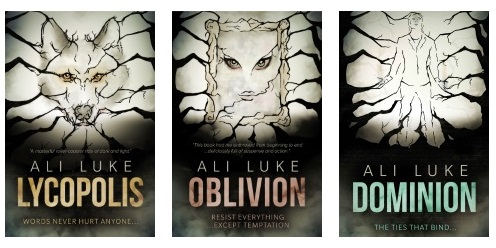
My contemporary fantasy trilogy is available from Amazon. The books follow on from one another, so read Lycopolis first.
You can buy them all from Amazon, or read them FREE in Kindle Unlimited.
0 Comments