
What Are Public Domain Characters (and Can You Use Them in Your Fiction)?
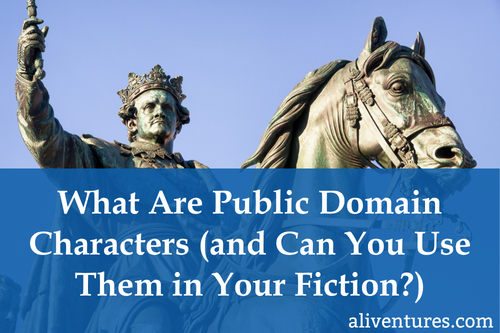
What are public domain characters … and can writers safely use them?
When I ran the Aliventures survey earlier this year, one reader asked about using public domain characters, and I thought that would make for a great blog post.
Let’s start with the basics – what do we mean by a “public domain” character?
What is a Public Domain Character?
A public domain character is a character that’s in the public domain, meaning that character can be used by any writer (or artist, etc). Think of characters like Dracula, Sherlock Holmes, Merlin, and Darcy: all immensely popular characters who’ve been used in many novels, TV shows, and films.
Public domain characters are normally characters from older works, either written before copyright existed, or works where the copyright has expired because the author died decades ago. (In most of Europe, works enter the public domain 70 years after the author’s death.)
It’s also possible to have a character that wasn’t copyrighted in the first place. For instance, the SCP Foundation (which I came across via qntm’s There is No Antimemetics Division) has a Creative Commons license that lets you use other authors’ characters within that wiki, as well as other aspects of their stories.
Public domain characters aren’t real-life figures. You can actually include any real-life person, historical or current, in a story – if they’re living, though, be careful about libel laws.
Is it Okay to Use Other People’s Characters in Your Story?
In a word … yes! So long as you’re using a public domain character, you can include them in your story, whether that’s in a large or small role.
This was once very normal in literature: many of Shakespeare’s tragedies, for instance, are based on earlier stories and characters. Malory’s Le Morte d'Arthur brought together and reworked lots of stories about King Arthur and the knights of the round table. The Robin Hood stories began as ballads and plays.
So there’s a great literary precedent for using existing characters, and there’s nothing wrong with doing this. In more recent times, plenty of authors have written acclaimed novels that use public domain characters: Jean Rhys’s Wide Sargasso Sea takes inspiration from Jane Eyre and tells the story of Rochester’s mad wife. P.D. James’s Death Comes to Pemberley is a murder mystery continuation of Pride and Prejudice.
What About Fanfiction?
Fanfiction takes existing stories, TV shows, films, etc and uses their characters and/or story world for new stories. It’s usually published online, either on personal websites or through fanfiction archives.
Generally, fanfiction isn’t going to land you in legal trouble: it’s a common, widely accepted part of fandom.
However, you can’t generally profit from fanfiction: that is, you can’t publish it for money.
While some fanfiction does indeed use public domain characters (Jane Austen fanfiction, for instance), the majority of fanfiction is about characters that are still within copyright.
When fanfiction stories get picked up by publishers, the character names (and some other details) will be changed. For instance, Fifty Shades of Grey started out as Twilight fanfiction; the character names were changed before it was published as an original novel.
Some Popular Public Domain Characters in Fiction (With Examples)
Wondering how public domain characters get used in novels (and TV and film)? Here are a few examples:
King Arthur, Merlin, and the Knights of the Round Table
These public domain characters have been around since medieval times. Just a handful of (very varied!) prominent works including them are:
- Sir Gawain and the Green Knight (narrative poem, late 1300s)
- Le Morte d'Arthur (compilation of stories, Sir Thomas Malory, around 1470)
- Idylls of the King (poem, Lord Alfred Tennyson, 1859–1885)
- Monty Python and the Holy Grail (comedy film, 1975)
- Merlin (fantasy-adventure TV series, 2008–2012)
Robin Hood
The earliest Robin Hood ballad is from the 1400s. The characters of Robin Hood, Maid Marion, Little John, Friar Tuck, and the Merry Men have been in the public domain for centuries – and they’ve been written about a lot!
Some key works are:
- Robin Hood and the Monk (ballad, written around 1450)
- The Merry Adventures of Robin Hood (children’s novel, Howard Pyle, 1883)
- The Adventures of Robin Hood (film, 1938)
- Robin Hood: Prince of Thieves (film, 1991)
Romeo and Juliet
Made famous by Shakespeare, the characters of Romeo and Juliet appeared in several other Renaissance works (including the Italian Giulietta e Romeo).
Since Shakespeare’s time, there have been many adaptations and reworkings of Romeo and Juliet – including films and novels that use versions of the characters. Too many stories to count use the “lovers from warring families” trope!
A few examples of stories using the characters more closely are:
- West Side Story (film, 1962) – a modern retelling, with a rivalry between two street gangs
- Gnomeo and Juliet (animated film, 2011)
- Rosaline (film, 2022) – a comedy from the perspective of Romeo’s former lover
Darcy, Elizabeth, and Other Pride and Prejudice Characters
Published in 1813, Jane Austen’s Pride and Prejudice is her most famous novel. The taciturn Darcy and witty Elizabeth have been picked up by many other authors since (and, of course, there have been numerous TV and film adaptations of the story). Some authors have chosen to follow other characters from the novel: Longbourn focuses on the Bennet’s servants, and The Other Bennet Sister focuses on Mary.
- Death Comes to Pemberley (murder mystery novel, P.D. James, 2011)
- Pride and Prejudice and Zombies (comedy mashup novel, Seth Grahame-Smith, 2009)
- Longbourn (historical novel, Jo Baker, 2013)
- The Other Bennet Sister (Janice Hadlow, 2020 – adapted into a TV series in 2026)
Sherlock Holmes
Sherlock Holmes (and Dr John Watson) are perennially popular characters, with numerous adaptations, including:
- A Study in Emerald (Neil Gaiman) – short story combining Sherlock Holmes & H.P. Lovecraft’s Cthulhu mythos
- Sherlock (TV series, 2010-2017)
- Elementary (TV series, 2012-2019) – with a female Sherlock
Peter Pan
Originally a play (in 1904) then a novel (in 1911) by J.M. Barrie, Peter Pan is the story of a “boy who never grew up”. Along with Captain Hook, Tinkerbell, the Darlings, and his gang of lost boys, he’s been a hugely popular character across films, staged versions, and novels. Here are a few key works:
- Peter Pan (Disney film, 1953)
- Hook (film, 1991)
- Lost Boy: The True Story of Captain Hook (Dark Fantasy Novel, Christina Henry)
- Lost in the Never Woods (YA Mystery Novel, Aiden Thomas, 2021)
Tips for Using Public Domain Characters in a Short Story or Novel
If you want to use public domain characters in your own fiction, whether that’s a short story or a novel, here are a few things to keep in mind.
Copyright May Still Apply
Be careful that you’re not infringing on someone else’s copyright (their depiction of the character). This usually comes up with visual art, not written works, but it could still be an issue if you use a particular trait or aspect of backstory that another author has developed more recently than the original work.
Your Reader Will Have Expectations
Consider what your reader already knows about that character. If a reader picks up a story about Robin Hood, for instance, they’re going to come to it with certain expectations already in mind. There’ll be things they expect to see (robbing from the rich and giving to the poor) as part of your story – and you may need to treat cautiously if you’re depicting a popular character in a very different way from canon.
You’ll Want to Add Something Unique
Think about the unique spin you’re going to bring to the character. That might involve taking them out of their original time and location – especially if you’re adapting their whole story – or perhaps you’re choosing a minor character and fleshing them out to become the protagonist of your story.
You may well be changing the genre (in a similar way to many of the examples above), or potentially rewriting the original story with radically new elements (like Pride and Prejudice and Zombies).
The Public Domain Characters Could Be Fictional Within Your Story
In many cases, you’ll be using public domain characters simply as regular characters within your story – whether they’re the protagonist or supporting characters.
But this can raise a question: if Sherlock Holmes appears as a character in your modern-day detective novel, does that mean that in your story’s world, Arthur Conan Doyle never wrote the Sherlock Holmes stories?
Some authors get around this by having public domain characters who exist as fictional or semi-fictional characters within the world of the story. (A couple of good examples of fictional-ish characters are Jasper Fforde’s Thursday Next series and Steffanie Holmes’s Nevermore Bookstore series.)
Whether you’re building a whole novel around a beloved public domain character, you’re writing fanfiction, or you just want to use a public domain character for a walk-on part, I wish you the very best of luck.
About
I’m Ali Luke, and I live in Leeds in the UK with my husband and two children.
Aliventures is where I help you master the art, craft and business of writing.
Start Here
If you're new, welcome! These posts are good ones to start with:
Can You Call Yourself a “Writer” if You’re Not Currently Writing?
The Three Stages of Editing (and Nine Handy Do-it-Yourself Tips)
My Novels
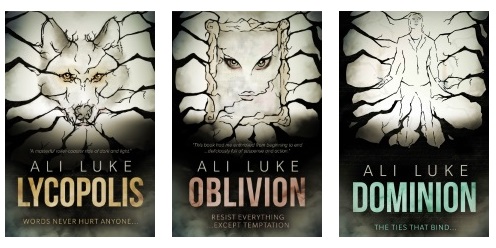
My contemporary fantasy trilogy is available from Amazon. The books follow on from one another, so read Lycopolis first.
You can buy them all from Amazon, or read them FREE in Kindle Unlimited.
0 Comments