
Understanding Personal vs External Stakes (and Using Them in Your Story)
Have you ever started a book that had a terrible, world-shattering event looming on the horizon … and yet you just didn’t care?
If so, it’s probably because the stakes didn’t feel personal. They were too big and too remote for you to connect with. But if something’s at stake for the protagonist – perhaps the loss of a friendship – then it can be a lot easier to get into the story.
Of course, external stakes matter too. Most of us aren’t going to read 80,000 words of a protagonist musing about the slow fading of a lifelong friendship. We want something to be happening in the plot to drive the story forward.
Before we dig into some examples of personal and external stakes (and how to make them work), let’s take a look at how these stakes aren’t quite the same thing as conflict.
Stakes vs Conflict
I’ve written before about internal conflict, external conflict, and the interaction between the two. And you might think that personal stakes (which we could call internal stakes) and external stakes are basically the same thing.
I think there’s a bit of a difference. What’s at stake is what a character stands to lose if they fail. That can absolutely lead to conflict – and usually should! – but you can have high stakes with low conflict (or low stakes with high conflict, for that matter). And in general, when the stakes are high, tension is going to feel high too.
Before we dig in too far, let’s look at another idea that’s closely related to stakes:
What’s at Stake in a “High-Concept” Novel?
You’ll sometimes hear agents and publishers saying that they’re looking for high-concept novels. This means a book with a strong premise that can be summed up in a sentence that essentially acts as an instant hook.
(For instance, the premise for The Hunger Games could be described as, “What if a dystopian future government made teenagers fight to the death as televised entertainment?”)
In general, a high-concept novel will have high external stakes. It’s not going to be focused on character growth or gentle exploration of complex relationships: instead, there’s going to be plenty of action and drama.
However, high-concept doesn’t just mean “make the stakes as big as you can imagine”. Sure, they might be massive – like in Project Hail Mary, where not just the survival of Earth but the survival of many other planets is at stake. But “world-ending” stakes on its own won’t be enough to carry your story.
What Types of Things Are Personal Stakes?
The personal stakes in your story might be something like:
- A friendship between two characters
- Finding somewhere to belong
- Coming to terms with grief
- Overcoming guilt about the past
- Having to choose between two love interests
- Discovering or forming a clear identity
- The risk of embarrassment or rejection
Personal stakes don’t have to be purely internal. They may well be bound up with a relationship, for instance. But they won’t affect anyone much beyond the character’s inner circle of close friends and family, and they won’t generally involve the possibility of serious physical injury or death.
What Types of Things Are External Stakes?
The external stakes in your story might be something like:
- A character’s life being under threat
- An evil or dangerous character trying to seize power
- Some kind of competition or tournament
- The survival of a whole group of people (a community, nation, etc)
- A natural disaster or other major catastrophe
- A journey or quest to reach a specific destination or accomplish a task
- A rescue of someone or something from danger
- A legal battle (e.g. a trial)
External stakes don’t have to be enormous to be powerful. In some cases, they’ll have a huge thematic or symbolic significance (e.g. when Atticus takes on defending Tom Robinson in To Kill a Mockingbird) but not a large impact within the story world (the trial won’t affect anything beyond the town of Maycomb, Alabama).
Examples of Both Personal and External Stakes – and How They Work Together
Let’s run through some examples of how the personal and external stakes within a story will overlap and work together.
Example #1: Pride and Prejudice, Jane Austen
In Pride and Prejudice, the external stakes are clear early on: the Bennets only have daughters, and there is an entail on their property, meaning the estate must pass to a male heir. The five girls, therefore, need to make good marriages in order to be protected financially.
The personal stakes for Lizzy are, of course, related to this. She has to decide whether to marry for security (which would mean accepting the tedious Mr Collins’ proposal) or for love. While she rejects Mr Collins, she goes on to marry Mr Darcy, who she genuinely loves – and who is immensely wealthy.
Example #2: Project Hail Mary, Andy Weir
In Project Hail Mary, the external stakes are pretty much as big as it gets: the whole Earth will be wiped out (and, we discover, other planets with sentient life too) if the problem of the “astrophage” slowly blotting out the sun can’t be solved. On a character level, the two main characters – Ryland and Rocky – will die if they can’t find a solution, and may well die in space regardless.
The personal stakes for the protagonist, Ryland Grace, are around him wanting to prove himself, after realising that he refused the mission out of cowardice, and around his fear of getting close to others (he tends to push people away to avoid rejection). It’s through his close friendship with the alien Rocky that they’re able to solve the problem of the astrophage.
Example #3: The Hunger Games, Suzanne Collins
In The Hunger Games, the external stakes are survival: Katniss and Peeta, from District 12, are up against the “tributes” from the 11 other districts in a deadly arena. On a bigger scale, the stakes are about standing up to an authoritarian government – and whether Katniss can do so without serious repercussions.
The personal stakes for Katniss are around her relationships with Peeta and Gale, and whether she can trust Peeta or not. There are also stakes around holding onto her humanity in the arena (such as when she sings to the dying Rue, instead of abandoning her). When Katniss and Peeta threaten to eat the poisoned berries, unless they can both be victors, they successfully get the totalitarian controllers of the game to change their minds.
What’s at stake in your story? If there’s not much at stake externally, tweaking this could improve the pace and drive your story forward. If the personal stakes are low, then your story might have more of an emotional impact if you give your character more to potentially lose.
Quick announcement: I’m running a free workshop on Monday (28th September) to help you come up with a clear, flexible plan for the rest of 2026. If you’ve not made as much progress with your writing as you wanted this year, now’s the time to turn things around! Get all the details here.
About

I’m Ali Luke, and I live in Leeds in the UK with my husband and two children.
Aliventures is where I help you master the art, craft and business of writing.
Start Here
If you're new, welcome! These posts are good ones to start with:
Can You Call Yourself a “Writer” if You’re Not Currently Writing?
The Three Stages of Editing (and Nine Handy Do-it-Yourself Tips)
My Novels
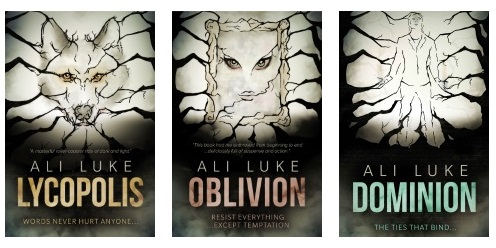
My contemporary fantasy trilogy is available from Amazon. The books follow on from one another, so read Lycopolis first.
You can buy them all from Amazon, or read them FREE in Kindle Unlimited.
0 Comments